Choosing a desktop microphone for a professional home studio means weighing trade-offs I kept running into while reviewing these ten mics: USB plug-and-play convenience versus XLR pro-audio flexibility, cardioid noise rejection versus omnidirectional pickup, and included bundles versus bare-bones builds.
I structured this review around the gaps that actually matter to buyers: connection types (FIFINE AM8, MAONO HD300T, and PD200W support both USB and XLR), pickup patterns (Blue Yeti offers four, CMTECK and T669 are fixed cardioid), and real-world extras like mute buttons, boom arms, and wireless dual-mic interview setups.
List of Best Desktop Microphone For Professional Home Studios
| Image | Product | Score | Link |
|---|---|---|---|
 | MAONO HD300T USB XLR Dynamic Podcast Microphone for PC & Aud 💰 Best Value | 9.0/10 |
View on Amazon Free Shipping & 30-Day Returns |
 | Logitech Creators Blue Yeti USB Microphone for PC, Mac, Gami 🏆 Editor’s Pick | 8.7/10 |
View on Amazon Free Shipping & 30-Day Returns |
 | MAONO PD200W Hybrid Wireless Podcast Microphone for PC, Dyna 👑 Premium Pick | 8.5/10 |
View on Amazon Free Shipping & 30-Day Returns |
 | FIFINE AmpliGame AM8 USB/XLR Dynamic Microphone for Gaming S 🥈 Runner-Up | 8.2/10 |
View on Amazon Free Shipping & 30-Day Returns |
 | MAONO A04 Gen2 XLR/USB Condenser Microphone Kit for PC Podca | 8.1/10 |
View on Amazon Free Shipping & 30-Day Returns |
 | FIFINE T669 Studio Condenser USB Microphone for Recording Po 💵 Budget Pick | 7.8/10 |
View on Amazon Free Shipping & 30-Day Returns |
 | Dejasound Upgraded Studio Recording Microphone with Isolatio | 7.2/10 |
View on Amazon Free Shipping & 30-Day Returns |
 | TONOR Studio Recording Microphone with Isolation Shield Set | 7.0/10 |
View on Amazon Free Shipping & 30-Day Returns |
 | CMTECK USB Computer Microphone G009, Noise-Cancelling Record | 6.6/10 |
View on Amazon Free Shipping & 30-Day Returns |
 | XTUGA MIS02 Recording Microphone Isolation Shield, 5 Panels | 6.2/10 |
View on Amazon Free Shipping & 30-Day Returns |
📋 How We Evaluated
Evaluation considers stated pickup patterns, connection types, included accessories, build details, and practical recording controls. Performance judgments rely on the supplied specifications rather than independent listening tests.
Amazon ratings and prices were unavailable, so neither rating signals nor value comparisons can be verified; suitability reflects the listed features and likely use cases.
Detailed Reviews
MAONO HD300T USB XLR Dynamic Podcast Microphone for PC & Aud💰 Best Value
| Microphone type | Dynamic |
| Pickup pattern | Cardioid |
| Connections | USB and XLR |
| Monitoring | 3.5mm zero-latency headphone output |
What We Found
The MAONO HD300T combines a dynamic cardioid capsule with USB and XLR connections, covering both direct computer recording and interface-based setups. Its front-focused pickup is intended to reduce unwanted background noise and room reflections.
In USB mode, a 3.5mm headphone jack provides zero-latency monitoring, with an integrated control for headphone volume. The included kit contains a metal desktop stand, shock mount, pop filter, USB cable, and XLR cable.
That package is unusually complete among the listed models, although no price is available to confirm its value. MAONO describes it for podcasting, singing, voiceover, streaming, and home recording. The supplied information does not state its frequency response or sample rate.
💬 My Take
The strongest all-around package here, thanks to dual connectivity and useful included accessories. Its missing audio specifications call for a listening check before serious studio use.
Who It’s For
This microphone suits creators who want a direct USB workflow today and a conventional XLR connection for a later interface upgrade. The dynamic cardioid design is a sensible option for a room with some ambient noise, especially when the speaker works close to the capsule.
Its included stand, shock mount, filter, and cables help reduce setup friction. It can serve podcasts, narration, and vocal practice, though users should verify sound quality for critical music work. With prices unavailable, compare its kit contents against the actual listing cost.
✅ Pros
- The package includes both USB and XLR cables.
- A shock mount and pop filter are included with the desktop stand.
- USB mode provides zero-latency headphone monitoring.
❌ Cons
- No frequency response or sample-rate figures are supplied.
- The included desktop stand may offer less positioning flexibility than a boom arm.
- Price data is unavailable, preventing a verified value comparison.
Logitech Creators Blue Yeti USB Microphone for PC, Mac, Gami🏆 Editor’s Pick
| Microphone type | Condenser |
| Pickup patterns | Cardioid, omni, bidirectional, stereo |
| Connection | USB |
| Software | Blue VO!CE |
What We Found
The Blue Yeti is a USB condenser microphone with a three-capsule array and four selectable pickup patterns: cardioid, omnidirectional, bidirectional, and stereo. That range supports solo narration, interviews, group conversations, and some instrument recording without changing microphones. Onboard controls include gain, headphone volume, pattern selection, and instant mute.
A desktop stand and adjustable pivot help position the capsule toward a voice or instrument, while zero-latency monitoring supports live level checks. Blue VO!CE software adds vocal effects and processing options.
The USB design keeps setup simple, but the supplied details do not list an XLR output or technical frequency specifications. No price or Amazon rating data is available for comparison.
💬 My Take
The most flexible straightforward USB option in this group. Its pattern selection is genuinely useful, but it is not the right fit for an XLR-first studio.
Who It’s For
This microphone suits creators who value multiple recording patterns and frequent changes between solo work and shared conversations. A podcaster can select cardioid for one speaker or bidirectional for a face-to-face interview, while stereo can serve some instrument captures.
It connects directly to a computer and offers enough onboard control for routine recording. However, a condenser capsule can pick up room reflections, so untreated spaces may need careful placement. Buyers planning an XLR-based studio chain should consider a different model.
✅ Pros
- Four pickup patterns support varied recording arrangements.
- Onboard mute, gain, pattern, and headphone controls are convenient.
- Zero-latency monitoring helps users check audio during recording.
❌ Cons
- The supplied details describe USB connectivity but no XLR output.
- The desktop stand occupies desk space and may transmit surface vibration.
- Condenser pickup can reveal room echo in untreated spaces.
MAONO PD200W Hybrid Wireless Podcast Microphone for PC, Dyna👑 Premium Pick
| Microphone type | Dynamic |
| Capsule size | 30mm |
| Connections | Wireless, USB, and XLR |
| Signal-to-noise ratio | 82dB |
What We Found
The MAONO PD200W stands apart with three connection modes: wireless, USB, and XLR. Its 30mm dynamic capsule uses a cardioid pattern, and the listing specifies an 82dB signal-to-noise ratio and a maximum 128dB SPL. Three-stage noise cancellation and MaonoLink app controls, including EQ and reverb, add flexibility.
A single receiver can connect two wireless microphones for separate-track interviews, according to the product details. Camera recording can stay synchronized, but camera and Lightning accessories are sold separately. The mix of wireless convenience and studio-style connections is ambitious.
However, the supplied information does not specify wireless range, battery life, or included accessories, and no price or Amazon rating is provided.
💬 My Take
A feature-rich option for interviews and mobile sessions, not the simplest desktop purchase. Verify wireless specifications and accessory costs before choosing it over a wired kit.
Who It’s For
This model suits mobile podcasters, interviewers, and creators who need to move between a desk, a computer, and wireless recording. Two-mic receiver support could simplify a two-person show, especially when separate tracks matter for editing. USB offers a convenient computer path, while XLR can join a larger audio setup.
The app may appeal to users who want hands-on sound shaping. Buyers should confirm battery life, wireless range, and accessory requirements before relying on it for location sessions.
✅ Pros
- Three connection modes accommodate varied recording workflows.
- A receiver can support two wireless microphones and separate tracks.
- The listing specifies 128dB maximum SPL and app-based sound controls.
❌ Cons
- Camera and Lightning accessories are sold separately.
- Battery life and wireless range are not stated in the supplied details.
- App processing features may add setup complexity for simple recording.
FIFINE AmpliGame AM8 USB/XLR Dynamic Microphone for Gaming S🥈 Runner-Up
| Microphone type | Dynamic |
| Pickup pattern | Cardioid |
| Frequency response | 50Hz-16kHz |
| Connections | USB and XLR |
What We Found
The FIFINE AmpliGame AM8 is a dynamic microphone with USB and XLR connections, giving creators a straightforward starting point and an upgrade path. Its cardioid pattern targets sound from the front, while the stated 50Hz-16kHz response covers a useful vocal range.
FIFINE recommends positioning the end-address mic two to six inches from the source. USB mode adds tap-to-mute with an LED reminder, headphone monitoring, and gain control. It also provides configurable RGB lighting, though those functions are inactive over XLR.
The feature set is aimed partly at gaming, but the dual connection options suit voice recording too. The XLR cable is not included, and the supplied information gives no price or rating data.
💬 My Take
A capable hybrid mic for close voice work, with useful controls and an upgrade path. Choose it for function, not its gaming lights.
Who It’s For
This mic suits streamers, podcasters, and voiceover beginners who want convenient USB controls now and the option to move to an interface later. Its dynamic capsule may be a practical fit for a lively room, provided the speaker stays close and addresses the mic correctly.
The headphone jack and gain knob make quick level adjustments easier during sessions. Buyers seeking a complete XLR setup should account for a separate cable and interface. RGB is a cosmetic extra, not a recording advantage.
✅ Pros
- USB mode includes tap-to-mute with a visible LED reminder.
- The XLR output allows an eventual move to interface-based recording.
- Onboard headphone monitoring and gain controls support quick adjustments.
❌ Cons
- The XLR cable must be purchased separately.
- Mute, RGB, and other function keys do not work in XLR mode.
- The stated frequency response is narrower than several condenser alternatives.
MAONO A04 Gen2 XLR/USB Condenser Microphone Kit for PC Podca
| Microphone type | Electret condenser |
| Capsule size | 16mm |
| USB resolution | Up to 192kHz/24-bit |
| Frequency response | 30Hz-16kHz |
What We Found
The MAONO A04 Gen2 is a 16mm electret condenser microphone with USB and XLR connectivity. In USB mode, its stated resolution reaches 192kHz/24-bit, with a 30Hz-16kHz frequency response.
The cardioid capsule is intended to focus on front-facing sound, and the included pop filter and foam windscreen help manage plosives and airflow. MAONO Link software provides gain, noise reduction, scene EQ presets, compression, and limiting over USB.
XLR use requires phantom power, and the software controls are unavailable in that mode. The dual connection design supports a direct computer setup or an interface-based chain. No price or rating data is supplied, and the listing says the mic is incompatible with Xbox.
💬 My Take
A flexible condenser kit for users who will use its USB software controls. Its high-resolution figures should not distract from room acoustics or the need for phantom power over XLR.
Who It’s For
This microphone fits creators who want detailed USB control and expect to experiment with software processing. It can handle voiceovers, podcasts, and content recording, while XLR connectivity offers a path toward an interface.
Condenser sensitivity makes room treatment and microphone placement important; a high sample-rate specification alone does not guarantee a better recording. XLR buyers must have phantom power available. The software tools are useful only in USB mode, so choose based on the connection you expect to use most.
✅ Pros
- USB and XLR connections support different recording setups.
- USB mode offers software gain, EQ, compression, and noise reduction.
- The kit includes a pop filter and foam windscreen.
❌ Cons
- XLR operation requires phantom power.
- Software processing is limited to USB mode.
- Condenser pickup may expose room reflections and background noise.
FIFINE T669 Studio Condenser USB Microphone for Recording Po💵 Budget Pick
| Microphone type | Condenser |
| Pickup pattern | Cardioid |
| Connection | USB |
| Arm reach | 30 inches |
What We Found
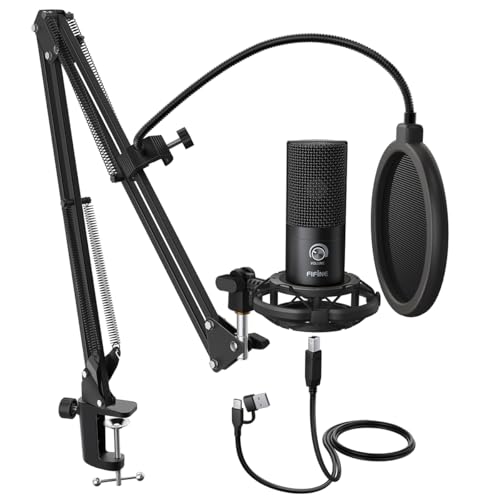
The FIFINE T669 is a USB condenser kit built around an included scissor arm, shock mount, and double-layer pop filter. Plug-and-play USB connection avoids the need for an interface or driver installation, making setup accessible for computer-based recording.
Its cardioid capsule is designed to focus on sound from the front and reduce ambient pickup. The steel arm rotates 180 degrees vertically and 135 degrees horizontally, with a stated 30-inch reach and a low-profile shape. An 8.2-foot cable and desktop clamp are included.
These bundled parts reduce the need to source basic mounting hardware separately. The listing provides no sample rate, price, or rating data, so detailed audio comparisons and value claims remain uncertain.
💬 My Take
A practical starter bundle when mounting hardware matters as much as the microphone. The missing technical audio figures make it difficult to judge recording quality precisely.
Who It’s For
This kit fits new podcasters, remote presenters, and voiceover creators who need a mic and mounting setup in one purchase. The arm can keep a microphone off the desk and out of the camera frame, while the pop filter helps control plosive bursts.
USB makes it convenient for laptop recording, but the listing says it does not work with Xbox. It is less suited to buyers building an XLR studio chain. Its practical value depends on the unlisted price and the fit of its clamp to the desk.
✅ Pros
- The package includes an arm, shock mount, clamp, and double pop filter.
- Plug-and-play USB setup avoids a separate interface.
- The low-profile arm offers useful reach for desk recording.
❌ Cons
- It does not support XLR connection.
- The listing does not state a sample rate or bit depth.
- Desk clamp compatibility depends on the user’s desk thickness and shape.
Dejasound Upgraded Studio Recording Microphone with Isolatio
| Microphone type | Condenser |
| Pickup pattern | Cardioid |
| USB resolution | 192kHz/24-bit |
| Shield dimensions | 27.55 × 10.23 inches |
What We Found
The Dejasound DJM5 is a USB condenser microphone bundled with a foldable isolation shield, tripod, and shockproof filter. Its listed specifications include a 16mm diaphragm, cardioid pattern, 192kHz/24-bit sampling, and a 30Hz-16kHz response. The microphone also provides echo and volume controls, a 3.5mm monitoring jack, and a mute button.
The shield uses five sound-absorbing panels and folds for storage or transport. The listing gives shield dimensions of 27.55 by 10.23 inches and a total kit weight of 4.1 pounds. These bundled pieces make a broad desktop recording package, but an isolation shield cannot fully soundproof a room.
No price or rating data is provided.
💬 My Take
A bundled entry-level recording setup with useful controls and portable panels. Treat the shield as a reflection aid, not a substitute for room treatment.
Who It’s For
This kit may suit a beginner who needs a microphone, basic monitoring, and a portable shield in one package. It targets vocals, podcasts, and home recording where reflections near the microphone are a concern.
The foldable panels can help manage some nearby reflections, but they cannot remove all room noise or replace acoustic treatment. The tripod is convenient for a compact setup, though it may not position the mic as flexibly as a boom arm. Check device compatibility and desk space before buying.
✅ Pros
- The package includes a foldable five-panel shield and tripod.
- Onboard mute, volume, echo, and headphone monitoring controls are listed.
- The kit is portable at a stated total weight of 4.1 pounds.
❌ Cons
- An isolation shield cannot fully block noise or correct poor room acoustics.
- The supplied details do not specify operating-system compatibility.
- The tripod may limit positioning compared with an adjustable boom arm.
TONOR Studio Recording Microphone with Isolation Shield Set
| Microphone type | USB microphone |
| Shield design | Foldable three-panel |
| Controls | Mute button and gain dial |
| Compatibility | Windows, macOS, PS4, PS5 |
What We Found
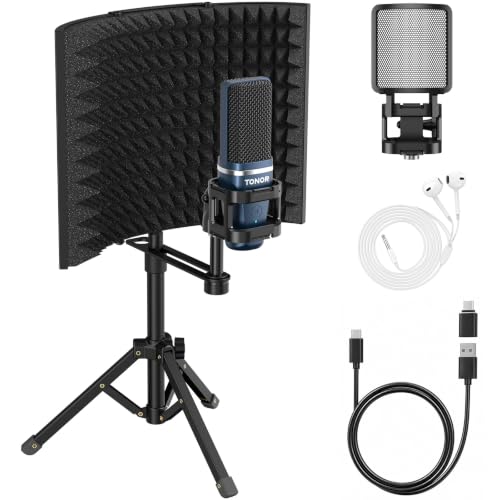
The TONOR TC777 Pro-IS listing describes a USB microphone package with a three-panel foldable isolation shield, tripod, earphones, USB cable, USB-C adapter, shock mount, and pop filter. Its controls include one-touch mute with an LED indicator and a gain dial.
The shield is described as using reflection, filtration, and absorption layers, while the adjustable metal tripod supports desktop positioning. The mic can also attach to a standard boom arm, sold separately. Listed compatibility includes Windows, macOS, PS4, and PS5, but excludes Xbox.
The package is aimed at quick setup for podcasting and voiceovers. No frequency response, sample rate, price, or Amazon rating data appears in the supplied details.
💬 My Take
A convenient accessory-rich starter bundle, but not a proven studio performer based on the supplied specifications. Consider it for general voice work rather than critical recording.
Who It’s For
This bundle fits a first-time podcaster or streamer who values included accessories and wants a quick USB setup. The shield, pop filter, and shock mount provide several basic tools for reducing reflections, plosives, and handling noise. It can also move to a boom arm if the user buys one separately.
The missing audio specifications make it difficult to assess studio performance, so it is better considered for general voice creation than demanding music production. Confirm that the listed compatibility matches the intended device.
✅ Pros
- The package includes earphones, a USB-C adapter, shock mount, and pop filter.
- A gain dial and LED mute indicator provide direct control.
- The microphone can attach to a standard boom arm.
❌ Cons
- The boom arm is sold separately.
- No sample-rate or frequency-response data is supplied.
- Xbox compatibility is explicitly excluded.
CMTECK USB Computer Microphone G009, Noise-Cancelling Record
| Microphone type | Condenser |
| Pickup pattern | Omnidirectional |
| Connection | USB |
| Positioning | Adjustable gooseneck |
What We Found
The CMTECK G009 is a compact USB condenser microphone designed for desktop communication and basic recording. Its omnidirectional pickup pattern captures sound from around the microphone, while the CCS2.0 noise-cancelling chip is intended to reduce background noise.
A pop filter helps manage plosives, and a mute button uses green and red lighting to show connection and mute status. The flexible gooseneck rotates for positioning, and the small base preserves desk space. It needs no driver or external power supply, according to the listing.
Compatibility includes Windows, Mac, and PS4, but excludes Linux, Android, and Raspberry Pi. The description does not provide sample rate, bit depth, or professional audio measurements.
💬 My Take
A convenient communication mic, but its omnidirectional pickup and limited technical detail weaken its case for professional studio recording.
Who It’s For
This model is best for online classes, dictation, calls, and casual voice capture where a small footprint and simple mute control matter. Its omnidirectional design can be convenient when speaking from different directions, but it is less targeted than a cardioid mic for isolating one voice in a noisy room.
The gooseneck makes placement easy on a crowded desk. It is not a strong match for buyers seeking detailed music recording or an expandable interface-based setup. Check operating-system compatibility before purchase.
✅ Pros
- Compact base and flexible neck suit limited desk space.
- Mute button includes a clear status light.
- Driver-free connection simplifies basic computer use.
❌ Cons
- Omnidirectional pickup may capture more surrounding room sound.
- The supplied compatibility list excludes Linux and Android.
- The listing omits sample rate and bit-depth specifications.
XTUGA MIS02 Recording Microphone Isolation Shield, 5 Panels
| Product type | Microphone isolation shield |
| Panel configuration | Three-panel or five-panel |
| Adjustability | Foldable panels and top |
| Mounting | Desktop or microphone stand |
What We Found
The XTUGA MIS02 is an isolation shield, not a microphone. Its five-panel design has four foldable end panels, with an adjustable arch and foldable top described for reducing reflections and some surrounding noise.
The shield uses multiple layers, including thickened foam, and can be arranged as a three-panel or five-panel setup. It can mount to a desktop or microphone stand, though the listing does not identify included stands or microphone hardware.
Its purpose is to shape the recording area around a separate mic, not capture audio by itself. No dimensions, measured acoustic results, price, or rating data are included in the supplied details, limiting assessment of fit and effectiveness.
💬 My Take
Do not mistake this shield for a microphone. It may complement an existing setup, but missing dimensions and mounting details make pre-purchase checks essential.
Who It’s For
This accessory suits a vocalist or podcaster who already owns a microphone and wants to experiment with controlling nearby reflections. Its adjustable panels may help in a small recording area, but they cannot isolate a voice from every room sound or replace acoustic treatment.
Check the shield’s dimensions, mounting requirements, and compatibility with the existing mic stand before purchase. It is not a standalone desktop microphone, so buyers seeking a complete recording device should select another product in this list.
✅ Pros
- The panels can fold into different recording configurations.
- The shield is designed to work with multiple microphones and stands.
- It may help manage nearby reflections around an existing microphone.
❌ Cons
- This product is an accessory and does not include a microphone in the supplied details.
- No dimensions or measured noise-reduction results are provided.
- Stand and microphone compatibility should be verified before purchase.
What to Look For Before Buying
Start by identifying what you record and how noisy your room sounds. A microphone that suits a treated vocal booth may disappoint on a reflective desk beside a computer fan. Decide whether direct USB convenience or an XLR interface matters more.
Then compare the complete setup, including mounting, monitoring, and connection accessories.
Check Match the pickup pattern to your room
A cardioid mic primarily captures sound from the front, which can help focus a solo voice. Dynamic models often suit untreated rooms when the speaker stays close. Condensers can capture more detail, but may also reveal room reflections and background noise. Omnidirectional designs can pick up sound from multiple directions.
Choose for your recording space, not a broad claim about studio quality.
Value Choose USB, XLR, or both
USB connects directly to a computer and usually makes the simplest starting setup. XLR requires an interface or mixer, plus the right cable and sometimes phantom power. A dual-output mic can support an easy USB workflow now and an interface later.
Check whether controls or software features stop working over XLR. Compare total setup costs, not just the microphone price.
Rating Check useful controls and monitoring
A headphone output can help catch clipping, room noise, or plosives before a session ends. Zero-latency monitoring matters when timing and immediate feedback affect your performance. A mute button is useful for live calls, while gain control helps adjust input level.
Software EQ and noise reduction can offer flexibility, but they do not replace good placement. Confirm which features work in your chosen connection mode.
Verify Inspect the complete kit and compatibility
Included stands, shock mounts, pop filters, and cables can reduce extra purchases. Check clamp dimensions and arm reach against your desk before relying on a bundle. Verify operating-system and console compatibility in the product listing. Treat isolation shields as reflection-control accessories, not complete soundproofing.
Since prices and ratings are unavailable here, confirm current listing details before comparing value.
Frequently Asked Questions
Which microphone type works well in an untreated home studio?
A close-positioned dynamic cardioid mic can help reduce room sound in an untreated space. It still captures nearby noise, so placement and recording level matter. Condenser microphones can capture detailed vocals but may expose more reflections. Test the microphone in the actual room before committing to a workflow.
Is USB or XLR better for a home studio microphone?
USB offers direct computer connection and simpler setup. XLR connects through an interface or mixer and can fit a more expandable recording chain. Some models support both, but controls may differ between modes. Check cable, interface, and phantom-power requirements before choosing.
Does a microphone isolation shield soundproof a room?
No. A shield may reduce some nearby reflections around the microphone, but it does not block all room noise. Results depend on its construction, placement, and the room itself. Use acoustic treatment and good mic positioning when room sound remains distracting.
What does zero-latency headphone monitoring do?
It lets a performer hear the microphone signal without the noticeable delay caused by computer processing. This can make recording and speaking feel more natural. It does not automatically improve the recorded sound. Confirm whether monitoring works in the connection mode you plan to use.
Can an isolation shield be used as a desktop microphone?
No. An isolation shield is an accessory that surrounds or sits behind a separate microphone. The XTUGA MIS02 listing describes a shield, not a recording microphone. Check whether mounting hardware is included and whether it fits your existing stand.
🎯 Final Verdict
The MAONO HD300T is the strongest overall choice in this group for a professional-minded home setup. USB and XLR connections support a simple start and a later interface upgrade, while the included shock mount, pop filter, and cables cover practical essentials.
Its dynamic cardioid design also suits close voice recording in less-than-perfect rooms. The Blue Yeti is a compelling alternative for creators who need four pickup patterns and convenient onboard controls. Compare current pricing and verify compatibility before buying. Choose the HD300T if its complete kit matches your recording workflow.

James Dimento is a Chief-in-Editor of SoundUnify. He is a headphone enthusiast and creative writer passionate about audio technology. He has three years of experience writing about headphones and sound quality and is responsible for creating reviews and taking care of all administration.